|
Regiment Origins
Since September 14, 1866 to Now
1939 ~ 1945
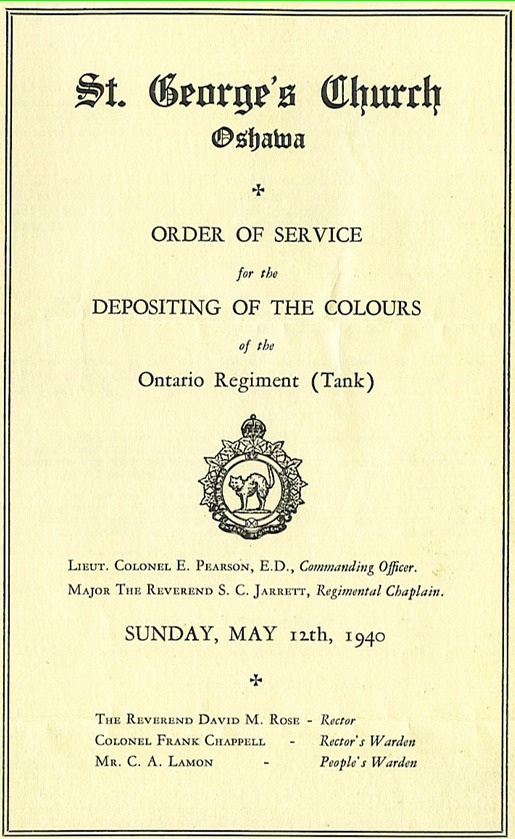
The Ontario Regiment (RCAC) is a Primary Reserve armoured reconnaissance regiment of the Canadian Forces Land Force Command. The unit based in downtown Oshawa, Ontario was first formed on September 14, 1866, and is more commonly known as the 'Ontarios', 'black cats' or 'ONT R' (pronounced "ON-tar"). The regiment motto in latin is, "Fidelis et Paratus" which means Faithful and Prepared. This regiment ranks among the oldest continuously serving Reserve (Militia) regiments in Canada and is one of the senior armoured regiments in the Royal Canadian Armoured Corps.
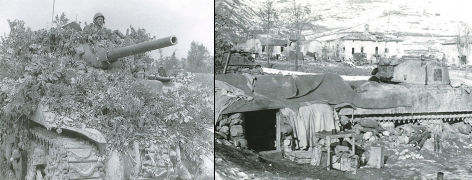
The unit was mobilized for World War II on September 4, 1939. Within six days 594 men had enlisted for active service. In June 1941, the regiment sailed from Halifax on the "Pasteur", arriving in Greenock, Scotland on the 1st of July, and headed south to Headley Downs, England. The Ontarios were the first Canadians to be issued the Churchill tank with which it trained in exercises in its experimental period of 1941-42. On 21 December 1941 the regiment moved to Brighton, alternating between here and Shermanbury park in operational roles in the defence of the English coast. The unit fought with distinction in several theatres during the war, beginning with the Allied invasion of Sicily in July 1943, through the Italian Campaign (World War II) seeing action in the fierce Liri Valley, Monte Cassino, and on to Ortona. In 1945, the unit entered the Northwest European theatre where it fought with distinction in the Dutch Campaign winning honours at Arnhem.
HISTORY
1st Canadian Armoured Brigade,
11th Canadian Armoured Regiment
(The Ontario Regiment, RCAC)
WWII deployment as part of the 1st Canadian Armoured Brigade,
Tour of Duty: Sicily and Italy, 1943 – 1945, Northwest Europe, 1945
The Canadian Military mobilized The Ontario Regiment (Tank), CASF on 04 September 1939. It was redesignated the 11th Army Tank Battalion (The Ontario Regiment (Tank)) on 11 February 1941. It embarked for the United Kingdom on 21 June 1941 as the senior tank battalion of 1st Army Tank Brigade. The Regiment was redesignated the 11th Army Tank Regiment (The Ontario Regiment (Tank)), and landed in Sicily as a part of the 1st Canadian Armoured Brigade on 13 July 1943. It was redesignated the 11th Armoured Regiment (The Ontario Regiment) on 26 August 1943. It landed in Italy on 03 September 1943 and moved to North-West Europe in March 1945.
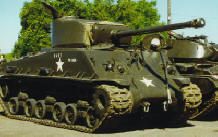
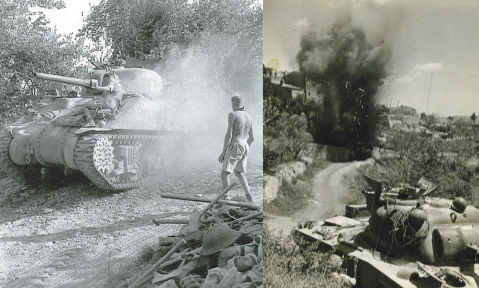
(Sherman M41A)
Battle Honours: Second World War Campaigns
Deployed to Sicily, 1943,
Pursuit to Messina, Aug. 2-17, 1943
Deployed to Italy, 1943-1945,
Colle d'Anchise, Oct. 22-24, 1943
The Gully, Dec. 10-19
Casa Berardi, Dec. 14-15
Ortona, Dec. 20-29
Torre Mucchia Dec. 29-Jan. 4, 1944
Point 59, Dec. 29-Jan. 4
Cassino II, May 11-18
Gustav Line, May 11-18
St Angelo in Teodice, May 13
Liri Valley, May 18-30
Aquino, May 18-24
Trasimene Line, June 20-30
Sanfatucchio, June 20-21
Arezzo, July 4-17
Advance to Florence July 17-Aug. 10
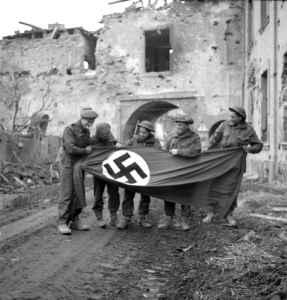
Deployed to North-West Europe, 1945
Arnhem, Netherlands, April 1945,
Holland, North-West Europe, May 1945
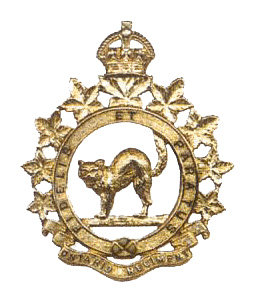
The Ontario Regiment badge above has been and is worn by every member regardless of rank and has significant symbolic representation. The origin of the cat is from the Clan MacGillivray familial crest, a member of which commanded the regiment in the early 1900s. The cat was redesigned into a fierce fighting pose echoing the experience of the regiment's members in the First World War and has provided the regiment the nickname “Black Cats” over time. The Ontario Regiment badge is topped with the crown of Canada's sovereign, currently the crown adopted by HM Queen Elizabeth II in 1953 but the pre-Elizabeth II WWII badge bore the George or King's Crown as seen above. The encircling wreath of nine maple leaves, represent the nine regions that originally made up Ontario County (pre-1949) for which the regiment is named. "ONTARIO REGIMENT" identifies the regimental title while "FIDELIS ET PARATUS", is Latin for the regiment motto of "Faithful & Prepared." Post World War I regulations forbade the identification of the unit’s traditional numerals identifying '34' Battalion so problem was solved by placing a circle at the base of the scroll and dividing it into four quadrants, one of which has been cleared, symbolizing the ideal of three of four or 34.
History of
The Ontario Armoured Regiment
The Ontario Regiment (RCAC) is one of the oldest continuing Regiments in Canada and one of the senior armoured regiments in the country. Militia units of Upper Canada have existed in what is now the Region of Durham since the earliest days of the 19th century.
The 34th Battalion of Infantry, 1837
The history of military units in “Ontario County” (now Durham Region) in the Province of Ontario can be traced as far back as 1837. In that year an infantry company was formed in Whitby that evolved into a Highland Rifle Company formed in 1856, by Capt James Wallace. Four years later, in 1860, this rifle company became part of the 2nd Battalion Volunteer Militia Rifles of Canada. This battalion changed its name in 1862 to the Queen's Own Rifles of Toronto, (later the Queen's Own Rifles of Canada). The Whitby Rifle Company became Number 6 Company of the Queen's Own. However, an important change soon took place in the battalion. Since The Queen's Own, successful recruiting, was able to fill its ranks in Toronto. The Whitby Rifle Company, therefore, became independent again in 1862. At this time there were nine independent companies in Ontario County. These companies were sent to the Niagara area during the time of the Fenian Raids, 1864-1866. Following their service at Niagara, these nine companies were reorganized in 1866 and given the name, the 34th Battalion of Infantry, with headquarters in Whitby. Company headquarters were located at Columbus, Brooklin and Uxbridge. Some members of the 34th Battalion saw active service later during the North West Rebellion of 1885, and the Boer War, 1899-1902. In 1900, the unit's name was changed from the 34th Battalion of Infantry to the 34th Ontario Regiment (Ontario, in this case, refers to the County of Ontario, not the province).
World War I:
The 116th and 182nd Battalions, 1914
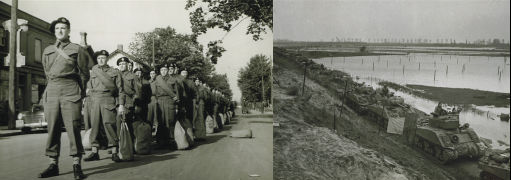
When World War I began in 1914, the 34th recruited soldiers from Ontario County for various Canadian overseas battalions. Enough soldiers had been recruited by September 1915 to enable formation of a full county-based battalion. This new battalion was assigned the number 116 and later a second battalion was also raised in Ontario County and assigned the number 182. The 182nd Battalion was broken up to reinforce other Canadian units that suffered heavy losses at Vimy Ridge while 116th Battalion fought valiantly in England, France, and Belgium, earning battle honours as follows: Somme, 1916; Arras, 1917; Vimy, 1917; Hill 70; Ypres, 1917; Passchendaele; Amiens; Arras, 1918; Scarpe, 1918; Drocourt-Queant; Hindenburg Line, Canal du Nord; Cambrai, 1918; Valenciennes; France and Flanders, 1916-18. After World War I, the 116th Battalion reverted again to become known as the 34th Battalion of Infantry and continued its training as an infantry unit with another reorganization of the Canadian militia in the mid-1930s.
World War II:
The 11th Armoured Regiment (Ontarios), 1936
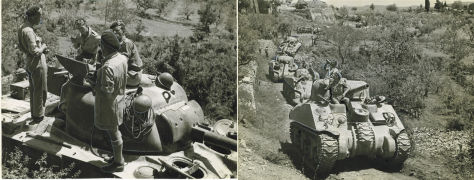
On the 15th December 1936, the unit, along with five other Canadian infantry battalions, was designated an armoured regiment within the Brigadier Frank Worthington's fledgling Canadian Armoured Corps and renamed The Ontario Regiment (Tank). It was with this title that the Regiment mobilized for war in 1939. The Regiment's name was changed to the 11th Canadian Armoured Regiment (Ontarios) in 1942 during preparations for its role in the Italy campaign. In 1943, the regiment entered action with the Sherman M4A1 Medium Battle Tank during the Sicily Invasion. With each crew of five men moving 32 tons of machine through the countryside at a top speed of 25 mph and wielding a 75mm cannon the Ontarios fought with distinction through Sicily, on through southern Italy and into the extraordinarily tough battles in the Liri Valley, Ortona and Cassino. After the fall of Rome and a short respite, the Regiment moved into Northwest Europe and fought through the lowlands earning battle honours during the campaign to liberate Holland.
The Regiment Today
There were two more name changes for the Regiment after World War II. In 1946, the Regiment was designated the 11th Armoured Regiment (Ontario Regiment) and in 1958, the Regiment assumed the title by which it is known today: The Ontario Regiment, Royal Canadian Armoured Corps (RCAC). During the post-World War II years, The Ontarios continued as an armoured tank regiment employing the Mark IV Sherman Tank and were the last Canadian militia units to give up their Shermans in 1972. The Ontario Regiment was subsequently re-roled as an armoured reconnaissance unit employing the M113 Lynx armoured reconnaissance vehicle, Ferret and Cougar armoured vehicles. Today, the Regiment is in the midst of adopting the Mercedes-built LUVW G-Wagon as it assumes its armoured reconnaissance tasking.
The Ontario Regiment, Royal Canadian Armoured Corps (RCAC)
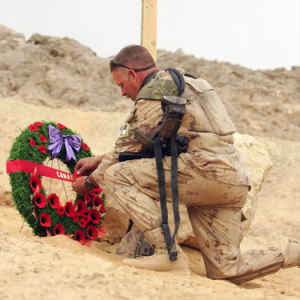
In recent decades, members of the Ontario Regiment have served on active duty with elements of Canada’s regular army including the 8th Canadian Hussars, the Royal Canadian Dragoons, the Lord Strathcona's Horse (RC) and Canada’s former NATO mechanized brigade, based in Germany until 1994. Many have seen active duty in a range of United Nations, NATO, or European Union-led missions in Cyprus, the Golan Heights, Cambodia, and the former Yugoslavia. Most recently, members of the Regiment have deployed to Afghanistan in support of Operation Athena. Since 2003, Ontarios have served in theatre and returned safely to Canada.
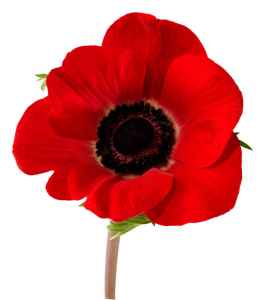
In Flanders fields the poppies blow
Between the crosses, row on row
That mark our place; and in the sky
The larks, still bravely singing, fly
Scarce heard amid the guns below.
We are the Dead. Short days ago
We lived, felt dawn, saw sunset glow,
Loved and were loved, and now we lie
In Flanders fields.
Take up our quarrel with the foe:
To you from failing hands we throw
The torch; be yours to hold it high.
If ye break faith with us who die
We shall not sleep, though poppies grow
In Flanders fields.
(We will never forget)
.
|