Lest We Forget - Continued stories of 11th, 12th, and 14th Canadian Armoured Regiments that our father may have told.
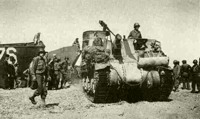
D-Day Drive to Holland The only change D-Day made to us was the fact that reinforcements were hard to get. And many of the wounded that were slated to go back home to Canada, (the third time wounded you went home rule), even that was cancelled. They had to return to their unit as soon as they were able. That's when Lady Aster called us the "D-Day Dodgers". Well, we all had a laugh at that. Yeah, we had turned in a day at the beach for two years in battle! Considering that, we thought it was a nice title. Why not use it!
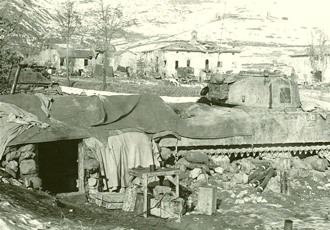
ONTARIO REGIMENT WINTER HQ 21 January 1945
We were up there on the Po River until the New Year. The 24th of February, they gave orders to pull us out and sent us to Leghorn and then from there to Marseilles. And from Marseilles, we went up to Menai, which was on the border between Belgium and France. A-Squadron did a shoot at Hogwall Forest and then we moved up from there to Nijmegen and Nykirke and did the square there at the end of the war. Nijmegen, Nykirke, Barnesville.
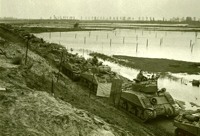
Our first action, immediately, was in Nijme-, just outside Nijmegen, in Holland. Now the 1st Canadian Corps, which we were part of in the Italian Campaign, were sent to the left to liberate Holland, and the 2nd Canadian Corps, which would have been in Europe since Normandy Invasion went to the left and started down into Germany. It was very, very wet because the Germans had destroyed a lot of the bridges and dykes. The country was pretty well flooded, but there, was the Dutch people, surviving, and they were wonderful.
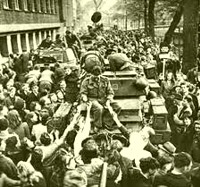
I can remember about a week before the war was over, there was a bit of a truce declared and food was trucked into Amsterdam. And thousands of people, just thousands, gathered for this, all this food that we hauled in there. And once the war was over, it took us nearly all day to go through the city of Amsterdam because you just couldn't move in the traffic of people. You couldn't travel because the people were out. We were attempting to roll out and there must have been 20 people on the tank. You could hardly see. You'd move two or three feet, and then stop. And they were climbing all over the tank; they were just so pleased to see us.
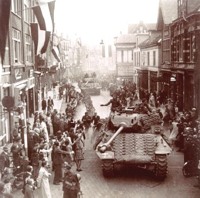
We were taking the last city in Holland, Apledoorn, when the word came, that's where the war ended. Fighting was heavy for about an hour and a half on the road going in but we got into Apledoorn, we stayed there for a day. I guess but the Germans just retreated. Then we were outside of Apledoorn and dug-in on May 8th when word came, "The war was over" You should have heard the screams and the hollers. After all these years that was the best sound. While it was exhilarating it was also surreal, you couldn't believe it. Everybody was happy. There was a big street dance there in Apledoorn, we got drunk. But we were sure glad it was over.
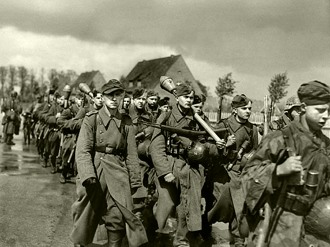
These are Armed German Troops Surrendering, Holland 5-5-1945
They may be surrendering to Canadians, but these are not beaten men. They still have fight in them and they're armed to the teeth. We Canadians were extremely nervous about last minute complications or misunderstandings. This event was 3 days before the general German surrender, so problems were more than possible. We didn't relax until all the weapons these guys were carrying had been secured. The kid on the right edge of my photo looks to be only about 14 years old.
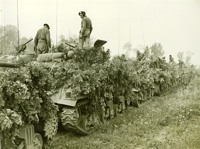
At the end they sent us up there to guard the camps, all the guards had fled but we couldn't let the people out without support services. It was hard to watch. They come rushing forward to see us but we had to try and get them to stay back, because at the same time they're hurting themselves on the barbed wire so their plight was getting worse, you know. And most of those poor people didn't have the strength too, oh it was a bad. We had to keep the outfit locked in because we were waiting for the arrival of the medical field units to come up. They wouldn't let us go in the camp too, you know, do anything for 'em and that bothered us. So we had to just stay there until the medics come up and then open the gates. When the medics came they sprayed the people and everything else to disinfect, Holy, it was awful, how anybody could treat people like these people were treated, God.
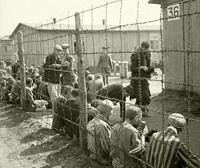 The kids in there were so skinny, so what you see in the movies is true, if anyone says there was no Holocaust, there certainly was. I saw this with my own eyes. We were only there a short time, you get relieved regularly because of he potential of disease or whatever it was. The medics were in there and fixed 'em up because these people were so bad off; they were lying down they couldn't even get up you know. I remember it and I don't want to remember it. They were like walking skeletons, and people lying all around the place. You didn't know if they were dead or alive and you know you could only imagine from looking through the barbed wire.
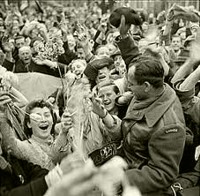
The Dutch people were very welcoming to us. They seemed to have no idea that those camps even existed in their country. As a nation they had been so deprived they needed a lot of food. Since we were good scroungers of fresh food, we lived off the land whenever possible and had lots of food leftover from our sea ration packs, we were able to give them food. We knew our next load of supplies was coming up soon anyway. We had a different feeling with the Dutch than we had in Italy. They were very cooperative. The people were so thankful and welcoming that Canadians or anybody were there to release them from the Nazis occupation. Although, at the end of the war, our last job was guarding German prisoners and protecting them from the Dutch underground.
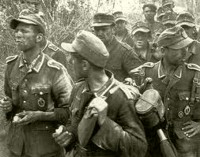 As the Germans surrendered, they were put into compounds and our job was to prevent the resistance movement from getting in and killing them because they'd given up all their arms and were all sitting ducks there waiting. Vulnerable was actually a funny position for Germans to be in. We were protecting the very people who, not too long ago, were trying to kill us but these were not the cream of the crop German infantry. These were mostly young teenagers, and I don't think half of those kids knew what the heck they were doing there anyway. So we finished up by disarming and protecting the Germans and sent them back across the border to Germany. We remained there until September. And then we were sent home.
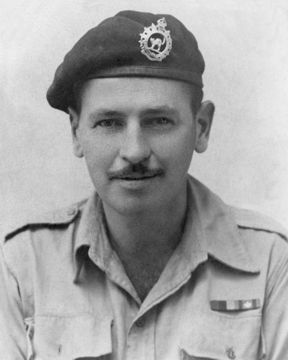
In peace time, is hard to comprehend life at war. I remember that day in the recruitment office after my big talking friends left. I was sitting there with a whole different group of guys, all strangers who would become a family forged by hardship and fire. Many of those guys did not make it. They gave their lives to defend the freedom to think and choose to our own way of life. Now, the truth of war has really been burned forever into my thoughts. Far from the bravado my friends shared over beers before enlisting, there is no swaggering or bravado, there is no guts, pride or honour in the process of war; it is a dirty business of bloodshed and atrocity that should only be our primal last resort to disallow global abuse.
A journalist recently asked me, if you were a younger man, and the circumstances were again, the same as they were in 1939, would you do what you did all over again? Yes, because I've seen too much injustice going on... The world figured, the 1918 war would be the last of the world wars until injustice was unavoidably pushed in our faces again. Then we figured there'd be no more after World War II but in the last ten years I don't think there's a place on earth that people are not being unjustly treated or even killed. There is still genocide in our globe. I don't want to be a politician but I blame the big governments. America, United Nations etc. for not being more proactive in a swift and potent stand against global injustice. There should be no room for these dictators, or the breakdown of human rights or starvation that occurs in places like Uganda, Bolivia, all over North Africa. Even in Europe. To me that's... where society has never learned their lesson. And this to me is the worst thing that's happening now. You read it everyday in the newspaper. There are still dictators, now there are cowards hiding in wait to strike terror into lives of good people, there are still people starving, they're dying... they're dying in the streets in Sudan, Ethiopia, for what? Didn't we fight the war to stop this? Or, is it my imagination that the similarity in the history and current global circumstance is just too wild a coincidence? I think not. To answer your question, I intensely regret and dislike the war action but yes I would do it again. We have to stop those who have no compassion and regard and no self-restraint in their action against others.
Today people criticize war because it is a dirty business but it is necessary to meet evil with equal or greater force to preserve the life that we all hold dear. While war should not be glorified, we should never forget those that stood between free society and the endless servitude of our children. We must maintain the memory of how bad war is with annual remembrance, public memorials, and statue symbols of our fallen, to remind us of the atrocity, to prompt us to take swift and potent peace time action to prevent history from repeating.



