Lest We Forget - Continued stories of 11th, 12th, and 14th Canadian Armoured Regiments that our father may have told.
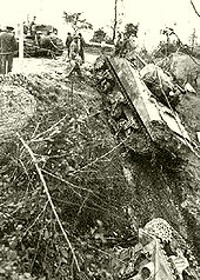
Casa Berardi. So we achieved several bridgehead advantages, but for another week there was continuous heavy combat that seemed to keep both sides pinned down in a stalemate over this narrow pit; a 200 foot deep ravine of death we called "The Gully" near Orsogna. After ten days of bloody struggle with high casualties we finally succeeded in outflanking German defences. With Vokes' new plan to attack the Gully defences from Casa Berardi, a small set of farm houses west of the Gully, and force the Germans to withdraw to the Ortona-Orsogna Line. Our job to outflank the Germans was no easy matter either. Captain Paul Triquet, pushed on towards Casa Berardi with support from our Ontario Regiment tanks. It was a fierce battle against strong German defences that caused heavy casualties; only 21 men and 5 tanks even made it to within 200 yards of the objective. So many friends fell in this battle, that for a time, success looked hopeless to our dwindling force. The chips were down but despite the arrival of several Panzer IVs, we were tenacious, there was no stopping us, and our remaining forces captured the manor house at 1430. Triquet would be later awarded the Victoria Cross for our capture of Casa Berardi.
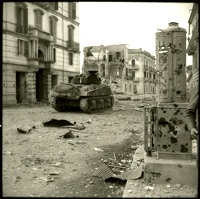
Battle of Ortona We then moved the tanks across the field and into the fighting at Ortona. The fighting at Ortona started with well placed Germans covering the streets and that's why we created the tactic of mouse-holing. This is where we'd move the tank into position behind the building and blast a hole in a wall at the beginning of a street because you couldn't go down the streets, they were too narrow and the snipers had them all spotted. So the infantry, that was with us would enter the houses safely to go in and clear that end house then blow out the next wall and clear each house out one at a time that way. The German snipers, didn't have a chance to get at our boys.
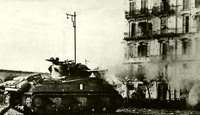
We fought in Ortona until the 29th of December. We moved, held our position until our infantry moved up on the far side. When the Germans saw that they were going to be cut off, they withdrew. The German 1st Parachute Division, had been set up in a church and hospital. For Christmas, on the 25th of December we spent our time knocking the church and the hospital down, brick by brick by brick.
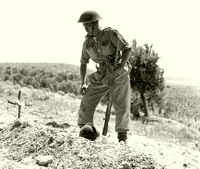
I lost my radio operator in a mortar attack. We went up to a meeting with command just after Ortona, and while waiting for the meeting we had a mortar attack. I was on the right hand side of the tank, my radio operator was on the other side. We were doing some work there you know, cleaning up or something. And the mortar landed on his side. Instantly killed him. The padre at the time came by. I was never intimate with him before he came over. I was surprised he knew all our names. He asked me what the matter was, I said "Well, Bert here is, I can't find him." I said a mortar came down and he was just gone. So we both looked around and found parts of his body, we gathered everything up and buried it with a small ceremony giving his last rights.
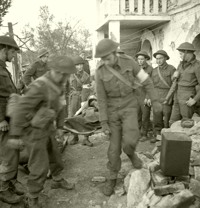
Its bad enough when you lose a friend in such a bloody way but then you have to deal with the green reinforcements coming in. They weren't very well trained most of those guys who came in. You'd say, "God, what have we got now, they're really scaping the barrel for youngsters." Some knew something, many knew nothing. They might have been in Italy for a while but they would still be green. There would be some who'd come back in after being wounded. But most of those new fellas would be so green, well you'd have to teach them how to use everything. Well, I'd tell them, "The greatest thing you need to learn in the Canadian Army, is how to stay alive!" You know you don't take stupid chances. So you had to teach them, and if they stay alive for a while they learn.
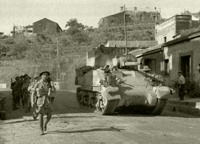
Just after we finished Ortona, we were told to stand down for a rest, but unlike the infantry, the rest only lasted a week or so. The green recruits went through us to take up a position the other side of Ortona, and the Germans beat the hell out of them. That was the worst part, they didn't really know what was going on, so we had to go back in and take over. We stayed there practically all winter, or I don't know how long, it seemed like an awful long time to me. When we were first there it was winter time we just lived right in the slit trenches. Up to our assholes in mud, what do you do but endure, the cold rain would come and you just had to deal with it. That cold rain would chill you to the bones but that's where we lived, practically most of that winter. Then they got us out on the move again.
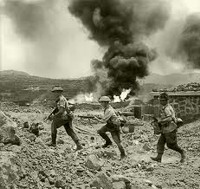
The next movement north of Ortona brought us up to take Pescara and we went in to support the Cape Breton Highlanders. As we moved up forging the way through the PPCLI line, we hit a mine and lost our left track, the bogey on the left side was blown off. Anyway, the whole thing worked out that we were left stranded about a quarter of a mile ahead of the holding line of the PPCLI. We spent three days guarding our tank in No Man's Land. The Germans tossed volleys of artillery and mortar shells and they also tried to send a patrol in to destroy the tank, but we were able to fight them off until our repair supplies arrived.
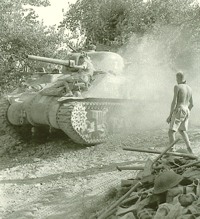
We were under constant fire contact with the enemy for a total of 283 days, from the 3rd of June '44 to the 24th of February '45. Our intensive drive to break through the German held Liri Valley, the Hitler Line and the Gustoff Line defensive positions was 283 days of continuous action. We made the final push to break the Hitler Line to Highway 1 with the Royal 22nd. The Germans had taken the turrets off dead tanks and built pill boxes with them. We supported the infantry by giving them covering fire while we took each defensive position out one by one, and we finally broke through to Highway 1 with the Royal 22nd. It was an interesting thing; one of the fellows went in one of the barns and found a German with a beam across his legs and being the normal idiots we were, the guy said to him, "Hi Fritzy. How does that feel?" He said, "I'd feel a lot better if you'd take this damn plank, beam off me!" Imagine that, he'd been educated at Oxford. We continued through, broke the hole in german line and the American 5th Div. rolled through our hole on their trip to Rome.
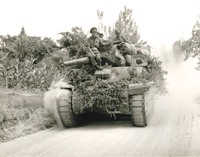
In fact, Rome could have been easily taken by Canadians. It was just a political decision upstairs that the Americans should be the first in. And our Colonel at the time, decided that he was gonna beat 'em to it just to show them. So we took a side road, went around Rome, and when the Americans rolled triumphantly through Rome, there was the Canadian Armoured Brigade already sitting there! We were all lined up on the road to greet them, on the other side of Rome.
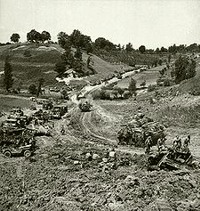
Italy was terrible country for a tank regiment operation. It was always one hill up and one hill down. Next hill. It was always very defensive. Italy was easy for the Germans to defend because they always had the upper hand. They had the higher ground and could look down. And every river crossing was contested. So when Rome fell it was a relief. We felt accomplishment, even if they rewrote the history books to downplay our efforts. Of course that would be considered to be a great victory for the Allies in Italy but we knew the truth of June 5th.
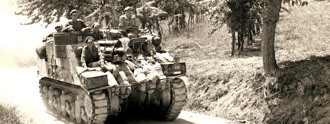
The Italy situation on June 5th was looking very positive but the war was not over. The very next day was the D-Day Invasion of Normandy and Northwest Europe. We were ordered north and we got to the Po River Valley area and looked out on the Lombardi plane, it looked like good flat tank country, but we all knew from the news that it had been flooded. Therefore the tanks couldn't move very well in mud, so we held there.



