Lest We Forget - Continued stories of 11th, 12th, and 14th Canadian Armoured Regiments that our father may have told.
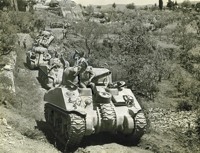
The Road to Rome Sounds of Fear in war are the incoming shells. Oh, the terrible sound of incoming 88's is indescribable. Moaning Minnie's, we called them. They would be like a dozen mortars going off all around us in a circle so every time they go around, bang, bang, bang, bang. You didn't know where they were going to land. Oh they were dreadful sounds. The German 88's were self-propelled tank gun shells, and they were devastatingly bad. We had the smallest gun in the Italian theatre; the Sherman Tanks gun was only a 76. I don't know how we won, with the smallest guns, probably because we had speed and we were clever. Our Great Gunners, made every shot count!
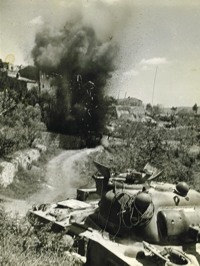
We didn't have the armament to compete with the German 88's but we found ways of doing it anyway. We lost a couple of tanks just figuring out that the German units had better range with their shells. We couldn't hit them because we couldn't reach them with our shells before they'd hit us with their 88's. Being in the faster Sherman tank, our strategy was to sneak up or chase the German's tanks. When we got close enough, since we had a 190 degree turret rotation circle we'd fire with our gun turret turned around... while hightailing it out of there. This made the Germans as vulnerable as us on distance because they were short on firing angle and just couldn't turn the whole tank around quick enough to return fire. They'd see we're running away faster than they could react and turn and yet we're still firing at them and knocking their tanks out while retreating. So that was a trick we learned during the war, to race in on a surprise attack to catch them off guard and start firing after we're retreating.
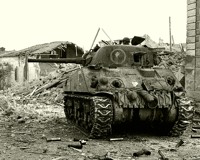
In one of the towns we went into, we were the lead tank going up the street, when a German tank just appeared in front of us out of nowhere. We were all shocked, there was chaos without order. It was only our gunner's instinct and quick reaction that saved the day. He just fired right away out of pure training instinct or impulse so we blew that Panzer up before they fired on us. It was just a shot in a million that he pulled off and didn't even know how he managed it afterward. That's either just dumb luck or the hand of Spirit looking after us, that happened to save the day.
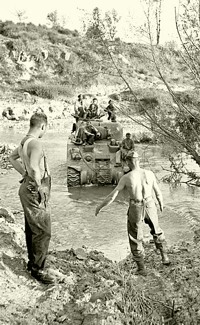
During the Italian Campaign, from Sicily up to northern Italy, we went through every season, of course. We were mostly moving through the central and east coast of Italy, which has a variety of terrain from mountainous to low lying river valleys and wilderness. It's very rugged there. Since we had a lot of rain to deal with in pretty messy terrain and because the tanks are easy to get stuck we were using donkeys to carry equipment, fuel, armament up to the front line because we just couldn't move the tanks or the trucks through the mud. That sometimes left us in this eerie position, like a powerful sitting duck, at times.
The winters were cold and harsh. It was certainly different than winters at home. We'd have snow, a lot of snow at night and cold rain by day. The cold dampness was the killer. Each morning, the sun would come up melt the land and there'd be mud. For three, four months of the year, it was nothing but mud we traveled in. We think of the mud, and we'd also think of the beautiful climate in the summer time, or on the coast where the temperature was very good, but in the mountains it was always cold; cold and miserable. Each night, we'd have to dig a hole to sleep in, most would go find a dryer spot on loose ground to make the digging easier, but my mate and I would go off and find a bombed out mortar hardened peice of ground and spend twice the time and effort digging-in. The others would think we were crazy. However, we had a theroy that "lightening won't hit the same outhouse twice" so we felt safer. Really it was the law of averages that made it seem to be safer when the sky would rain mortar shells throughout the night. There were those mornings that we'd discover someone had dug in an unlucky place.
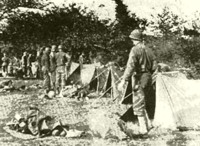
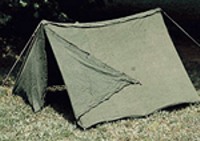
In the winter, what we used to do when we dug-in for the night, we'd dig a hole about, about four feet deep in the ground. And then because there was no escape from the drainage water we would dig a little sleeping ledge on each side of it to stay out of the wind. We'd put a pup tent over it and sit on our ledge-bed, with our feet out of the water in the deeper hole. For warmth, we always had plenty of oil, so we'd take an empty five and a half inch shell casing, and bore a row of holes around the base of it to make a little makeshift stove and stuck it in the bottom of the hole. We put an oil and water mixture in it so burned like a torch. That little fire in the bottom of the hole is the way we heated the bedroom. Our Puptent Motel is how we lived. Our feet and blankets would be wet all the time, but at least still warm; we survived. From your hole you wrote home nearly every week but you weren't allowed to say very much. You were not to mention where you were, what you were doing, but you could say general things like it was raining today, or something like how you felt. You wouldn't talk about what was going on around you, whether you'd been fighting or just on the standby or anything else, that might provide intelligence about the forces to the enemy if your letter was intercepted.
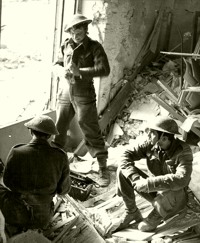
We Canadians felt completely forgotten until we had a visit from Colonel Ralston, who was the National Minister of Defence and represented Prince Edward Island in the Canadian Government at that time. I can remember quite well, when he came in to visit the fighting units. We were all lined up very proper army style. He said, "Break ranks and gather 'round me." So we gathered in a circle around him. He said, "Now have you got any complaints?" And one of the infantry boys from Charlottetown, was very outspoken. He said, "Yes, we gots lots a complaints." He said, "The uniform I have on is English." He said, "We don't have any Canadian uniforms here.
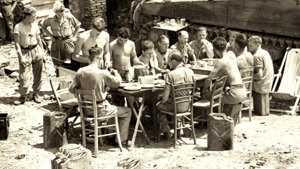
We're getting all English stuff." He said, "Dere's de English unit down the way and dey get a bottle o'Canadian beer every week. We don't! all we gets is English beer." He said, "Dey get Canadian cigarettes while we get English cigarettes. And he said dese limy cigarettes ere tree-n-one. Tree shovels of horse manure and one of tobacco. An," he said, "Dese here are da tings we tinks is wrong!" Well this gentlemen from Charlottetown turned to our commander as he pointed his finger at the outspoken fellow and said, "If you crime this man..." Now, crime means to make a misdemeanor report in the army. "...for speaking out, I will personally crime you." Within one week, we had a Canadian beer. We had Canadian cigarettes, and we all got new Canadian uniforms. This was how we were remembered. So when we got a visit from the National Defence Minister, everything can happen!
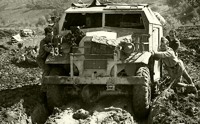
The Moro River. The crossing of the Moro River is our opening move in the fight to gain San Leonardo Di Ortona. It is also the start of the bloodiest month of the war for Canadians in Italy. Heavy rains turned it into a muddy swamp making it very difficult for tanks and heavy vehicles to cross. Our opening objective to taking Ortona, was to confront the German 10th Army-Panzers and its "Winter Line Defensive System. On December 6, 43 we began a series of major assaults on strategic crossing points along the Moro River. Our forces attacked Villa Rogatti to the west; the small town of San Donato, near the Italian coast while we hit San Leonardo, 5 kilometers south of Ortona. It was essential to put a bridge across the nearby Moro River.
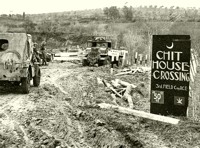
Exposure to enemy positions means it is difficult to build or repair crossings quickly enough. Heavy fog during the initial period meant little air cover. For two days the German Defence was relentless but on December 8 1943, Major General Vokes launched a new plan to take the Moro River that began with a massive artillery barrage that pounded the Germans continuously for two hours. Eventually, we managed to establish strong positions on the western ridge overlooking San Leonardo. Despite enemy shelling during the night of December 8/9, units of the Royal Canadian Engineers constructed a bridge over the Moro, to allow armour and equipment to move into San Leonardo the following day. Near the end of December 9th, German forces fell back to their second defensive line: a formidable obstacle known as "The Gully".



