Lest We Forget - Continued stories of 11th, 12th, and 14th Canadian Armoured Regiments that our father may have told.
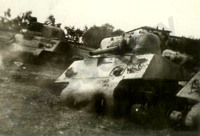
Invasion of Italy As far as we were concerned, the invasion of Italy began with the Landing at Reggio that went on as planned. The Americans came up the west coast of Italy and we came up the east coast. When we were to make the landing in Italy they told us, "there's no problem there, everything is fine," but we found out differently. Our big problem was the inferior armament we had on the tanks because the Germans with their 88's could hit us at a distance without possibility of our returning the fire. They used to sit behind the sand dunes just waiting for us to come up the beach. Since we couldn't see anything there, all they had to do was fire on us, and just like that disaster would come at us as a surprise. It was a challenge just to get off the beach as this picture of burned out tanks on the beach shows. However, once those of us survived to land successfully, the mission was on as there were airports we needed to liberate there. Through heavy fighting we captured them very quickly to give the allied air force a chance to come in. Then we moved on up from there to Bari. The next really big battle we had coming was, Termoli. That was a battle where we lost quite a few tanks.
At the time, we believed the Italian theatre of war, was the war; it was supposed as the allied start point to push the German's back out of occupied countries, but what did we know? As it turns out, we were set up by the British to be the distraction away from the real plan to be implemented later. While the capture of Naples and of the Foggia and Rome airfields would be beneficial to any future attack, the actual objective was not so much to conquer Italy as it was to force Germany to divert some of its forces to focus on this southern front we created. By dividing Nazi forces between several separate fronts, the Allies would prevent Hitler from striking a deadly blow at the USSR or from concentrating an invincible defensive position along the coast of Normandy, where the secret plan for the real invasion was to take place. The allied deception was so extensive it even included a corpse to wash up on the coast of Spain, an apparent courier with secret allied documents outlining very detailed invasion plans for an invasion commencing on the coast of Greece that would draw Hitler to also divert forces from Italy to strengthen defenses on yet another, albeit fake allied battlefront.
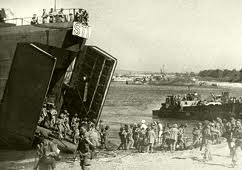
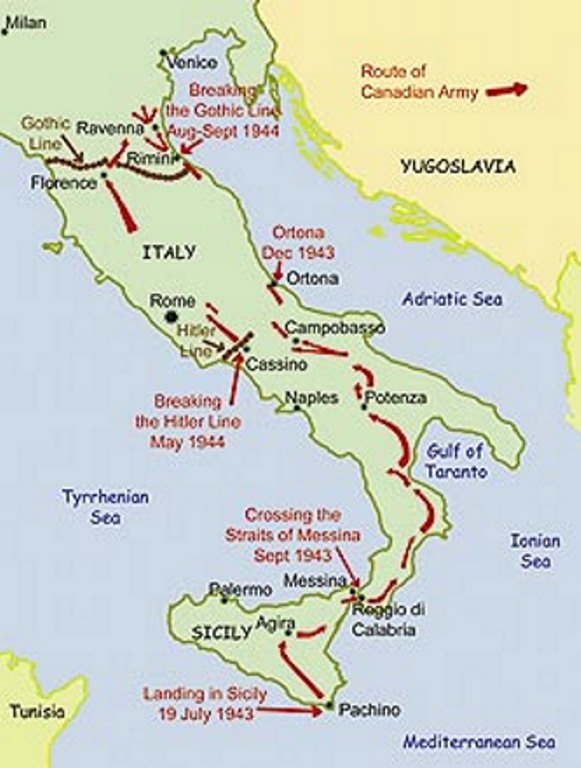
Our allied assault across the Strait of Messina into mainland Italy began on September 3, 1943 and our initial landing on Reggio di Calabria, met little resistance. Italian garrisons that were left to defend this area quickly deserted their positions and fled into the hills; the only German unit in the area, part of the 29th Panzer Grenadier Division had retreated into the mountains two days earlier. It's no wonder Sicily fell with little resistance since the Germans had planned and already withdrawn their limited forces to establish their most opportune line of defence across the narrow, mountainous part of the central Italian peninsula. We captured Reggio, and slowly made our way through the rugged the Aspromonte Mountains and along the Gulf of Taranto to Catanzaro. We were often slowed down by the collapse of bridges that the Germans had sabotaged as they withdrew. In spite of rain, poor mountain roads, German sabotage and rearguard actions, we were 75 miles inland from Reggio by September 10. The fighting in Italy, was to be bitter. Taking prior advantage of natural geography in the mountain peaks and swift rivers the Germans had made every Allied advance difficult and very costly, they would make us pay for every foot of ground we gained. Still, by September 21st, allied forces had formed an uninterrupted front line that reached completely across the Italian peninsula, from Salerno in the west to Bari in the east.
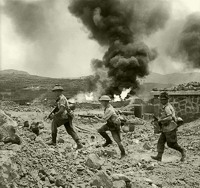
By the end of September, the German hold on northern and central Italy was still unshaken. The Allies had overrun a vast and valuable tract of southern Italy, and our armies stood on a line running across Italy from sea to sea. The next objective was to take Rome, all we had to do was break through the German defence line. As we drove north from Naples and Foggia, we found ourselves pushing into the central mountain range. Here the enemy dug in and resisted with full force. On October 1 at Motta, we fought the first really heavy battle with Germans in Italy, and there followed a series of brief, but bloody actions. On October 14 we took Campobasso, the next day we took Vinchiaturo, and the advance continued across the Biferno River. Enemy casualties were heavy as the Germans learned to respect us. During the same period, one unit of our Tank Brigades played a distinguished role on the Adriatic coast, where they supported a British assault at Termoli and the advance to the Sangro River.
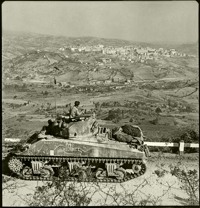
Meanwhile the US Fifth Army met stiff German resistance as it assaulted the beaches of Salerno. It was therefore vital for the Eighth Army to advance toward the rear of the German defence and assist in the U.S. breakout from the bridgehead. With this in view, a Canadian brigade was diverted from the main Canadian line of advance to seize Potenza, an important road centre east of Salerno. The operation was a real obstacle race among mines and blown up bridges, extremely demanding on the engineers. When we entered Potenza, enemy resistance collapsed immediately and Potenza was taken on September 20. The breakout was accomplished, and on October 1, the Fifth Army entered Naples. In the meantime, the 1st Canadian Infantry Brigade proceeded eastward, to join the Airborne Division in the Taranto region, and then pushed boldly inland to the north and northwest. The 5th British Corps seized the Foggia airfield.
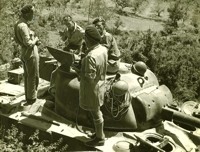
Until then the German strategy was simply to delay our progression as much as possible to buy time for reinforcements to be sent. Their commanders had orders to retreat until they could take solid positions between the Bernhard Line that cut across the Italian Peninsula from Gaeta in the west to Ortona in the east. That defensive line protected Rome and the Germans had clear orders: The enemy shall not pass!
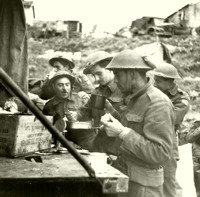
In the 63 days since landing, the Eighth Army had covered 450 miles. However, the "pursuit from Reggio" was now over. The Germans, with their strength now almost equal to that of the Allies and having the advantage of choice defencive positions, meant to make a stand from the coast south of Cassino on the Naples-Rome highway, to Ortona on the Adriatic shore. The winning of Rome would not be easy.



