Lest We Forget - Continued stories of 11th, 12th, and 14th Canadian Armoured Regiments that our father may have told.
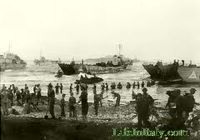
The Road North So far I have been unable to find out how the Americans did, but from our position on a cliff top near the main beach, where I am writing this, with the fleet near by and landing ships and warships spread out in the bay, I can see smoke and hear gunfire some miles inland on the front. Apparently we are gaining ground steadily, with naval bombardment support still going on. All day long our fleet of landing ships, cargo vessels, and Royal Navy ships have been in the bay disembarking men by the thousands, and discharging vehicles, guns, and supplies. Other units from Nova Scotia, New Brunswick, and Quebec landed during the morning and afternoon.
The bridgehead had been established by the time they were sent in, and they began to march to the front. It is now five in the afternoon, and there hasn't been an air attack against us. It seems incredible that we aren't bombed, but RAF planes are continually patrolling in our area as the Canadian attack is linked closely with British formations. Big battles probably will come to the Italy campaign before long, but meanwhile large numbers of prisoners are being captured. The prisoners have been passively coming back from the front since dawn in batches of 50 to 100 guarded by only one or two Canadian soldiers.
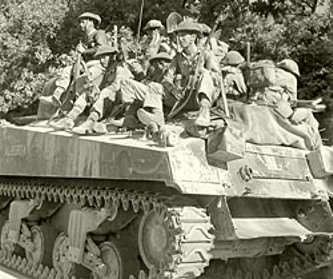
As we began to push up from Pachino Beach, on the left-most flank (with five British divisions to our right), we were yet to face the harsh realities of the Italian terrain. Italy, Sicily included, is dominated by rolling hills, mountains, and deep-cut ravines and valleys. With very little left of the motor pool due to the U-Boat attack, our boys were hitching rides on our tanks and walking the heavily mined roads in our effort to chase and trap the Italian and German forces on the island. The nature of the chalky soil in Sicily with the hot summer sun made conditions very difficult for us. The air was filled with fine dust kicked up from the soil, and the kind of heat was something we weren’t accustomed to (unlike the British and Americans who were battle-hardened in North Africa).
We learned early the Italians were probably forced to fight and didn't want to fight anymore, and we became very good friends with some of the Italians. Now they might have had some that continued to fight, but we found that if you got up against them it wouldn't be too long and they were gone because they just didn't want to fight. Now the Germans were different, especially the SS, they would stubbornly hold their ground; they just didn't want to move. And if they moved at all, you were gonna pay the debt dearly. They were good fighters who had the equipment, they were hard, and they were just egotistically stubborn. So then we became hard and stubborn too.
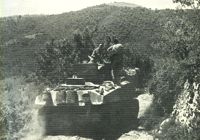
On Eighth Army's far left flank we Canadians continued to push forward through choking dust, over tortuous mine-filled roads in a wide sweep of sporadic fighting but it was becoming clear that German units settling into their new positions in north eastern Sicily would not have sufficient strength to carry the whole front. Piazza Armerina and Valguarnera fell on successive days, As a result, we were ordered to continue north to the hill towns of Leonforte, then to turn eastwards to Adrano and Assoro on the south-eastern slopes of Mount Etna, thus abandoning the originally planned encirclement of Mount Etna using Route 120 to Randazzo. Despite the defensive advantages which mountainous terrain gave to the Germans, after bitter fighting both places fell to our assault. Even stiffer fighting was required as the Germans made a determined stand on the route to Agira. Three successive attacks were beaten back before a fresh brigade, with overwhelming artillery and air support, succeeded in dislodging the enemy. On July 28, after five days of hard fighting at heavy cost, Agira was taken.
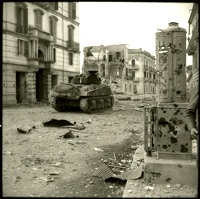
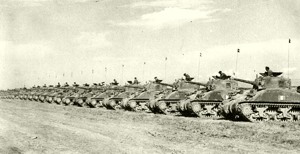
Right from the beginning we had to figure ways to overcome superior German tanks. One of these ways we called Tiger hunting. The Sherman's 75mm gun was useless against anything but the Tiger's rear so, it was a very high-stakes game of chicken. To go after a Tiger tank, in the Italian hill towns, the rule of thumb was that you needed five of our speedy Shermans. Three Shermans would out-maneuver the Tiger to get it backed up against a wall or a house. The other two hidden Shermans would prepare to fire into the structure. The idea was to have at least one Sherman loaded and ready to fire directly at the rear of the Tiger as the other one brought down the last wall that hid them.
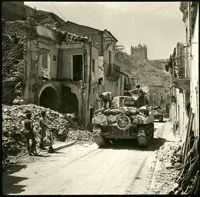
Well into the final days of Sicily we took Regalbuto and we started to move up north to the Plains of Catania. Catania is the capital of Sicily at the bottom of Mount Etna. The American's were on their way north to Palermo. The British were coming up towards Catania too. We didn't have much resistance there. We were just going straight on, hell bent for leather. Our final task was to break through the main enemy position and capture Adrano. Here, we faced more than enemy troops, but rugged physical barriers, an almost trackless country. Mortars, guns, ammunition, and supplies all had to be transported by mule trains. Undaunted, we advanced steadily against the enemy positions, fighting literally from mountain rock to mountain rock until we achieved our goal. With the approaches to Adrano cleared, we prepared for the closing of the Sicilian campaign but on August 7th we received orders, "You're going into rest period now, for a couple of weeks, and prepare yourself to go into Italy." We were angry, after all we had done, we were ordered to wait for the rest to catch up to be in the newsreel pictures. Eleven days later, British and American troops entered Messina to announce Sicily had been conquered in 38 days.
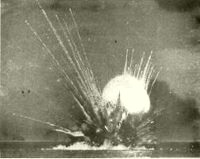
Everything happened so quickly after we stood down. Before we realized it the Germans retreated so quickly, many enemy troops had managed to escape across the Messina straits into Italy. Had we been ordered into Messina instead of standing down we may have stopped their escape to prevent them from becoming part of the bloody force we would later face in Italy. The narrow straits were protected by 120 heavy and 112 light anti-aircraft guns. The resulting overlapping gunfire from both sides of the strait was described by Allied pilots as worse than over the Ruhr making daylight air attacks highly hazardous and generally unsuccessful.
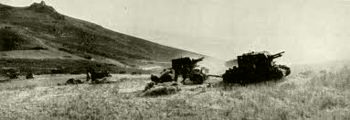
The Sicilian campaign was a success. Strategically, Operation Husky achieved the goals set out for it by Allied planners. The operation had secured a foothold and necessary air base to support the liberation of mainland Italy. It also freed the Mediterranean Sea lanes and contributed to the downfall of Mussolini, thus allowing a war-wearied Italy to sue for peace. And it opened the way to the Allied invasion of Italy. The casualties on the Axis (German-Italian) side totaled 29,000, with 140,000 (mostly Italians) captured. The US lost 2,237 killed with 6,544 wounded and captured; the British suffered 2,721 dead, with 10,122 wounded and captured; the Canadians suffered 2,410 total casualties including 562 killed with 1,848 wounded and captured. For many of the American forces and for the entire Canadian contingent, this was their first time in combat.
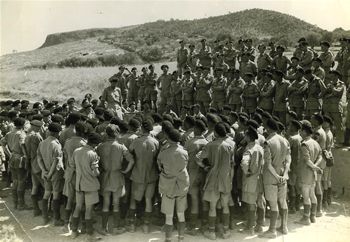
General Montgomery visits Ontarios in Sicily 25-July-1943
We did well in the first campaign. We had fought through 240 kilometers of mountainous country - farther than any other formation in the Eighth British Army. During our final two weeks, we had carried a large share of the fighting on the Allied front. I would say we probably lost five tanks and the personnel; we lost our friends, during that battle. We took it as it comes. I don't think we had any time to think about it. That was the basis of it... when you're fighting war, you haven't got time to think about who died, who disappeared, who's wounded. Nobody knew. You just keep going.



