Lest We Forget - Continued stories of 11th, 12th, and 14th Canadian Armoured Regiments that our father may have told.
By this point in the war, no Canadians had seen action against the Germans with the very extreme exception of a handful of First Division men who landed in Dunkirk in 1940, only to be immediately evacuated again. It wasn’t until August of 1942 when men of the Second Canadian Division went ashore at Dieppe, a raid that proved disastrous and led to more than 900 Canadians being killed with a further 2,462 being captured, wounded, or both. This poorly planned British introduction to war for the Canadian troops was appalling, but none the less didn’t sway the individual soldier’s determination to fight. Prime Minister Mackenzie King wasn’t entirely keen on sending what few divisions Canada had into doomed engagements due to manpower shortages and the need for North American and British garrisons, but by 1943 Canadian commanders were eager to redeem themselves. So, we embarked from England in late June, 1943, for staging in North Africa.
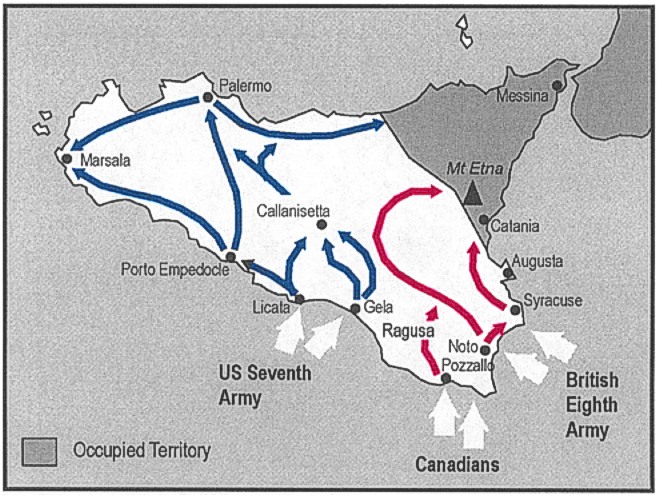
Invasion of Sicily, was codenamed Operation Husky. It was a large scale amphibious and airborne operation, followed by six weeks of land combat that launched the Italian Campaign. Husky began in the early morning hours of July 9, 1943, with reconnaissance photos and reports indicating a highly fortified landing area that would prove a deadly obstacle. During the voyage from Gibraltar to Sicily, we were attacked by submarines. That's what we were told. Out of 3000 ships and landing craft of the assault armada a couple of troop carriers and cargo ships were hit with loss of the bulk of the Canadian motor pool, 500 vehicles and guns and 58 men. As we're sailing through the nighttime, we could hear their calls, "Help." "Save us." We all put on our lifesaving jackets and we sailed right by them. That was the most, well one of the worst impressions I have ever had. That really affected me, that here we are, listening to guys that are dying until they sunk, and we can't do anything about it. You're in convoy and a convoy just doesn't stop. For most of us, this attack was the first definite sign that fighting in this war was more than just news reports.
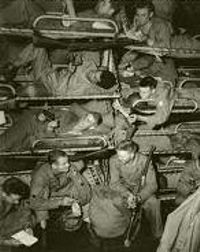
There was a welling of feeling in utter dismay, knowing that we would soon face certain death from concrete pillboxes, barbed wire, and tank traps. The landings were plagued by rough seas and poor weather and a number of the landings were late. You may only imagine the thoughts going through any of us as the flat-bottomed landing craft smashed into the waves and the mist flew over our heads. We were expecting bloodshed, a lot of bloodshed, and with craft landing on wrong beaches, hours behind schedule, and in poor weather, the situation could only be made frieghteningly worse.
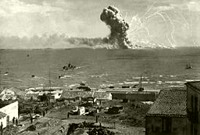
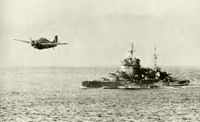
From about midnight air forces plastered the Pachino Peninsula, and a terrific series of bomb explosions and the light from burning Pachino, set afire by the RAF squadrons, helped guide us in. The big warships of the allied fleet stood offshore a few miles and added to the din with tremendous salvos that shattered the night.
July 10 1943 (0134 hours) Transports carrying 1st Canadian Division released landing craft toward the shore of Pachino, southwest of Italy. Target beaches are code-names Roger (on left), and Sugar (on right). (0245 hours) Operation Husky begins, the Allied invasion of Sicily. Four British divisions of the British 8th Army under General Sir Bernard Montgomery land on a 40-mile stretch of the southeast corner around Syracuse and Cape Passero. Four American divisions of the United States 7th Army under Lieutenant-General George Patton land on a 40-mile front to the west, around Scaglitti, Gela, and Licata.
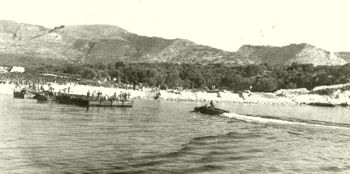
(0645 hours) Over 26,000 men in Canadian forces, the 1st Canadian Infantry Division and 1st Canadian Tank Battalion were commanded by Maj. Gen. Guy Simonds report successful landings at Sugar on Sicily. (In total, 478,000 troops land on the island.) Following an enormous nighttime naval and air bombardment, we practically walked into Sicily today. As it turns out, the recon reports couldn’t have been more wrong. We were able to breathe a sigh of relief as we landed on the beaches to find only stone houses and farmer’s fences as opposed to something more comparable to Hitler’s “Atlantic Wall” of strong fortifications.
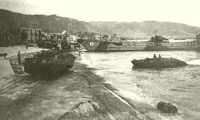
As we landed stubborn resistance was put up by the Italians north and west of Pachino, and along other sectors of the front there were heated engagements. Two companies had landed shortly ahead of us on our beach, and they and some sappers seemed to have a sharp engagement, but broke through the weak defences in about fifteen minutes. A supporting group landed shortly after the assault units. In many cases only a few scattered shots were fired as the few Italian defenders rapidly broke down and retreated. The reality coming soon after the worst imaginations seemed almost like comical relief, but the ease of the landings would quickly turn into a fleeting memory in the days to come.
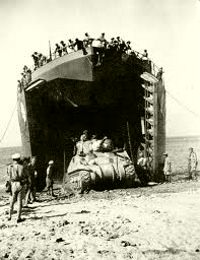
It was a most fantastic spectacle to see and hear as two assault units stormed the left sector. When I landed at 5:15 this morning there was scarcely a shot fired as we passed through the wire and our troops infiltrated into the countryside. We smashed through beach defences as soon as we were set ashore, and then attacked inland, establishing an extensive bridgehead which was our initial task in the 8th Army invasion plan. Other than those initial confrontations we met very little determined resistance on their beaches four miles southeast of Pachino on the southeast tip of the island. So far Canadian casualties appear to be very light. On one beach there were only a half dozen men wounded where two assault units landed.
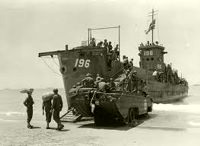
Having secured the Pachino airfield, we headed northwest to make contact with the American right wing at Ragusa. We drove off the 122nd Italian Infantry Regiment north of Pachino. After landing we met stubborn resistance put up by the Italians north and west of Pachino, and along other [Canadian] sectors of the front there were heated engagements. Big battles will probably come before long, but meanwhile large numbers of prisoners are being captured.



