Lest We Forget - Continued stories of 11th, 12th, and 14th Canadian Armoured Regiments that our father may have told.
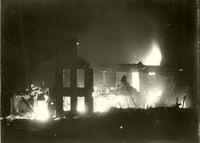
Landing in England Soon after arriving in London we were billeted with civilians where I got my first taste of the bombing. The bombers used to come at night. I'd never seen anything like it, the bombers banged London relentlessly, it was so bad, but after a while they became commonplace and we didn't seem to notice it. I suppose you can get used to anything if it happens often enough. Although, that first time I was there when they started pounding, "boom, boom" it was shocking. The explosion was way down the street, blew the whole street apart. They train you to get under cover. Everything shook and the two of us dove to the floor, underneath the sink I think. Imagine it, two grown men underneath the sink and there was our host, still up and walking around, you know, still fixing dinner! I was yelling at her to get down but she was so used to it, you know the bombers used to hit almost every night. She was just as calm as anything and we felt foolish, the two of us soldiers underneath the sink. So that was my first impression of war. It was the surprise that was scary. But you know, it made you wonder deep down inside, if we did that here in this woman's kitchen, crowding under the sink because of the noise, what the hell are we going to do when we get to the front?" You know, "What kind of a soldier am I gonna, be?" The truth is, you learn and become numb, it grows on you, and like our host you can get used to anything. After a while you just got the, the sounds, eh! When to duck, or jump, or we somehow knew when one was coming near, so forth and so on, eh, but it took a while to get used to it, eh. Even the sounds of the shells and that, you knew them, which were bigger ones, smaller ones, and you knew about how far away they were because it helped you to stay alive, eh. After a while you just, you did your job and you weren't doing anything out of the ordinary, so you, just did it, that's the way you went.
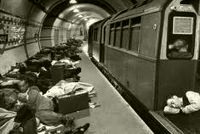
I think the people in England were amazing. I used to go into London at various times, but they carried on in their own way. It was amazing. They treated us very well. Oh they had very great respect for us. More so, than the Americans. I wouldn't say they went out of their way to be polite, they were always polite. Strong willed and courageous as they took things in stride, they knew they had to go in the shelter, take their blankets with them or their mattress and they used to sing and dance there. During air raids we used to go down in the underground, what we call the subway here, and they had beds there and when the sirens rang they all went down quietly. No problem. Everything was carried on just as orderly as they were any other hour. Which amazed me. These people... they were just going to be randomly killed. No worry at all. No worry whatsoever.
The army food was... unmentionable. They served us mutton. Morning, noon and night. I've never tasted mutton in my life, but I had mutton in every shape or form during those months. You name it, the cook made it out of mutton. And one time actually we had a protest. It started like a ripple effect through the squadrons but we decided to refuse the food. And the officer of the day came around, says "You know you're up for mutiny if you carry on like this." And one of the boys turned around in the mess, gave him the plate, and he says "Would you eat this?" He tried it, he says "No." They went ahead and fired the cook, brought in one of the motor pool sergeants made him a cook and we started to get better food. How, I don't know, I don't even know if he'd ever seen the inside of a kitchen in his life, or maybe he just had teachings from his mother, but he had the desire like the rest of us. All we cared was we started to get better food. But that was one of the main events that happened there, was that "Salisbury Food Riot."
Waiting for War We felt ready from the day we got to England. We were anxious to get into the war. Not that we weren't in it, but we wanted to go into battle. But this, sitting around for months waiting to die was mentally worse hell than battle. We were sitting on the plains there for almost two years while the hierarchy of command at that time said that they're not ready to put us in. Finally our General McNaughton had a meeting, and told the generals of the British Army, because the war was under British control we took orders from the British, but in that meeting he threatened to take the Canadian Army out of England back to Canada. "You don't put us into action," he said, "I'm going to pull our troops out. We're not going to just sit here on our backsides." That's when they got serious and planned the Dieppe mission. It was funny you know, people don't think of the Canadian as a soldier, but when we were told to do something we did it. Never mind the consequences. That was our attitude there and our war records show how strong and respected Canadians were in the battlefield.
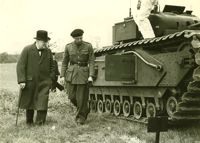
We trained so long while waiting to be deployed that all of us became armoured specialists in all the various jobs that we were doing. But we started off in England with the Matilda tank, and that wasn't the tank that we needed to use. Then we got the Churchill tank, which was also unfit. It was a lumbering giant with a two pound gun that was no match for anything the Germans had. Eventually we got the Sherman tank. It was a good tank and we had confidence in going into action because with that we could stand up against the Germans. We were five guys in the tank: driver, co-driver, gunner, radio operator, and the crew commander. And our training was such that we could all interchange into any role and very often did. Each position is essential but the radio operator was the difficult because at that time we used Morse Code, we only had a small intercom between the various tanks in a squadron. And the gunner's job was difficult only because he had to do the calculations to fire the gun accurately, often under extreme time pressure. Each function is so essential that we had to know the other crewmember job's. We would find out later that our very survival depended on the requirement that if anyone was hurt or something, we had to replace them right away, until replacements came from the rear.



